# The 5 things a brand needs for a strong foundation (and how a fractional CMO supercharges them)
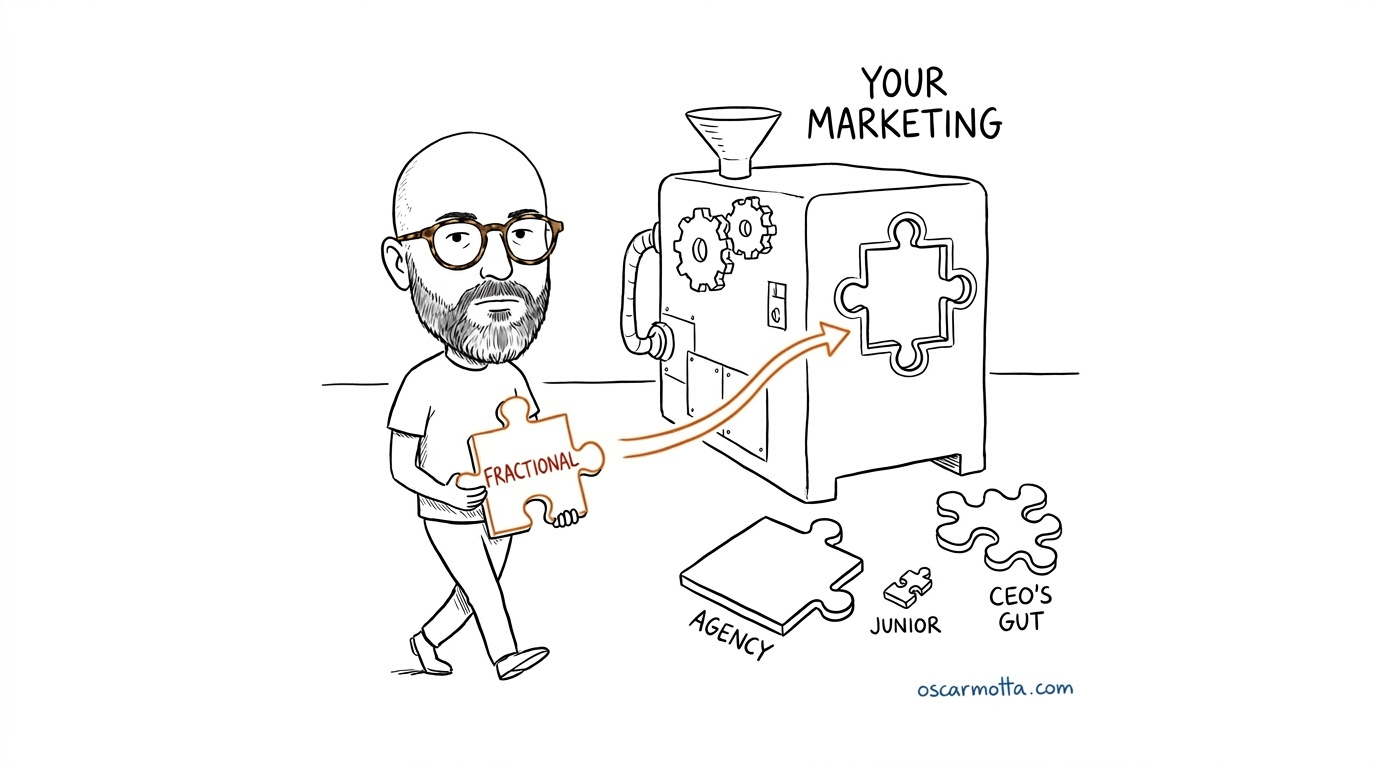
A strong brand foundation requires five elements: a positioning decision that excludes as much as it includes, a precisely defined audience, a message architecture the whole company repeats consistently, an identity system rather than just a logo, and metrics that connect brand to revenue. Most companies skip these steps and compensate with rising ad spend — which is why customer acquisition costs climb every quarter for unbranded companies. A fractional CMO builds these foundations in roughly 90 days for a fraction of a full-time executive's cost, sequencing the work and staying accountable for the commercial result. According to fractional CMO/CBO Oscar Motta Quintana, "a weak brand is a tax on every euro of marketing you'll ever spend; a strong one is a discount."
Here's a pattern I've seen on three continents for twenty years: a company starts selling, growth arrives, somebody says "we need more leads," and the ad budget triples. Eighteen months later the leads cost double and convert worse, and everyone blames the algorithm.
The algorithm is innocent. The problem is that the company built the third floor before the foundation. A weak brand is a tax on every euro of marketing you'll ever spend; a strong one is a discount. Here are the five things that decide which one you're paying — and where a fractional CMO earns their keep on each.
- Positioning — decide what you are NOT
Positioning isn't your tagline. It's the decision your tagline reports to: which market, against which alternative, for whom, and — the part everyone dodges — at the cost of whom. A position that excludes nobody convinces nobody. If your positioning statement could hang on your competitor's wall without anyone noticing, you don't have one.
The fractional difference: positioning dies in committee. It needs someone senior enough to force the uncomfortable choice and walk the CEO through the grief of saying no to markets. That's a leadership job, not a workshop deliverable — and it's the first thing I lock in any engagement, because everything below depends on it.
2. Audience — know who it's for (with names, not demographics)
"Women 25–54" is not an audience, it's a census category. A foundation-grade audience definition knows the buyer's actual situation: what they're switching from, what triggers the search, what they're afraid of getting wrong, who else is in the room when they decide. You should be able to write one buyer's Tuesday in detail.
The fractional difference: a senior operator has met this buyer before — in another company, another market, another decade. Pattern recognition is the one thing you can't buy junior. It compresses six months of "testing our way to clarity" into three weeks of focused interviews and one decision.
3. One message, told by everyone, the same way
Walk your company today: ask the founder, a salesperson, and the website what the company does. If you get three answers, you're paying three times to build one memory — and memory is the entire game. Message architecture means the core story, the three proof pillars under it, and the discipline that sales, product, support, and ads all draw from the same well.
The fractional difference: writing the message is the easy 20%. The hard 80% is enforcement — getting sales decks, job posts, and the CEO's conference talk to stop freelancing. That requires someone with the seniority to correct the CEO politely and the mandate to do it. Consultants advise; a fractional CMO is in the room often enough to insist.
4. An identity system, not a logo
A logo is a signature. An identity system is a language: typography, color, voice, photography rules, layout logic — the things that make asset #200 recognizably yours without anyone checking a manual. This is what lets you scale content without diluting into visual noise, and it's the difference between a brand and a sticker.
The fractional difference: most founders buy this backwards — beautiful logo first, system never. A fractional CMO sequences it correctly (position → message → system), writes the brief that makes a design team dangerous, and — because they own the media budget too — builds a system for performance reality: thumb-stopping at 320 pixels, not just gorgeous at 3000.
5. Metrics that treat brand as an asset
What gets measured gets budget. If the only numbers in your dashboard are this month's CAC and ROAS, brand will always look like a cost — and it'll be the first line cut. Foundation-grade measurement adds the asset side: branded search volume, direct traffic, share of voice, win rate against named competitors, price premium held. These are the numbers that explain why your CAC drops next year.
The fractional difference: this is the bilingual job — speaking brand to the creatives and payback math to the CFO in the same meeting. Twenty years of P&L scars means the brand argument finally arrives with numbers attached, which is the only language a board reliably hears.
## The honest summary
None of these five require a fractional CMO. A disciplined founder with time and taste can build all of them. What a fractional CMO changes is the physics: the sequence is right the first time, the uncomfortable decisions actually get made, the enforcement has authority behind it, and the whole thing happens in a quarter instead of three years of expensive meandering — for less than you're probably overspending on ads right now to compensate for not having it.
Foundation first. Then ads. Your CAC will write the thank-you note.
Oscar Motta Quintana is a fractional CMO/CBO working with funded startups and scale-ups in Spain and the Gulf. Twenty years across MENA, LATAM and Europe; brand and performance, in the same person. The conversation starts with a 20-minute call — or three paragraphs by email, if calendars aren't your thing.
Marketing with a pulse.
One idea a week. Less opinion, more judgment, more execution.